
In
Side
F A L L 2 0 1 1
As the editor and publisher of
Tusca loosa’s enter ta inment
weekly, Linda Johnson knows
what’s cool.
But it took a heart attack to show her
what it really means to be cool. Doctors at
DCH Regional Medical Center used a new
procedure to take her body temperature
down to 91.4 degrees. Te process is called
induced hypothermia, and as Ms. Johnson
can attest, it can be the key to bringing a
heart attack patient back from the brink
of death. And luckily for her, the Regional
Medical Center has made induced hypo-
thermia standard practice.
ANOTHER DAY AT THE OFFICE
OnApril 8,
2010, Ms. Johnson would have told you
she was too busy to be sick. Not only was
she working to get her publication Planet
Weekly to press, but she was also work-
ing on setting up the frst crawfsh boil in
downtown Tuscaloosa.
“I had been under tremendous stress,”
she said. “I was putting in 14-hour days
putting out the magazine and doing pub-
licity and organizing for the crawfsh boil.”
Tat evening, she went home and put
up some tomato plants with her father,
Clayton Winters, who lives nearby (as
HEART ATTACK TREATMENT
IT’S SO
COOL!
does most of her family). She fell into bed
exhausted that night.
Ms. Johnson’s next memory is waking up
in the Acute Cardiac Care Unit asking for
ice cream. She doesn’t remember calling her
sister or 911. In fact, she doesn’t remember
anything about the next few days, but her
sister picked up the story in a diary she
kept during Ms. Johnson’s hospital stay.
“I received a phone call from Linda,”
Paralee Kelley wrote. “She was saying,
‘Help me! Help me! My chest is hurting.’ I
dropped the phone and took of over there.
“When I got in, she was laying on the
couch, not very responsive. She wasn’t
breathing good at all. I called Mom and
Dad, and they got there. I kept praying for
the ambulance to get there.
“Here comes the ambulance. Dad
opened their door and started letting them
know something was wrong. Tey got an
oxygen tube down your throat, started
giving you air. Your heart had stopped.
I just thought, ‘Tis can’t be happening.’
Tey shocked you twice and got your heart
beating again. Ten they got IVs started.
“I remember asking them if your heart
was beating, and they told me no. I felt my
heart leaving my body, my feelings leaving
my body. Ten your heart started back,
and I knew you were going to be fne. Te
paramedics got you in the ambulance, and
they headed of to DCH.”
At DCH Regional Medical Center,
Emergency Department physicians and
nurses stabilized Ms. Johnson, and a car-
diologist implanted a stent in her cardiac
artery to open blood fow to the heart. But
because she had to be shocked back to life
three times before she got to the hospi-
tal, Ms. Johnson needed a dramatic new
therapy—induced hypothermia.
A NEW APPROACH
During a heart at-
tack, blood fow to the heart is blocked by
plaque in a heart artery. If the blockage is
severe, heart muscle dies when it is de-
prived of oxygen. Tat’s what causes the
pain associated with a heart attack.
But if the heart stops, the patient is in
—Continued on page 2
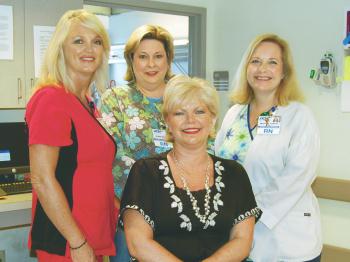
TOGETHER AGAIN: Linda Johnson (seated), who was 48 when she had a heart
attack in April 2010, is surrounded by some of the registered nurses on the
Acute Cardiac Care Unit who cared for her during the month she was on their
unit. From left are ACCU nurse manager Carol Morris, Jennifer Hall and Martha
Junkin.
ANNUA L R E POR T
GET THE FACTS ABOUT HOW DCH—AND THE PEOPLE OF DCH—
ARE SERVING YOUR COMMUNITY.
SEE PAGE 5.
real trouble. During a full cardiac arrest, ev-
ery organ in the body is deprived of oxygen,
and one by one, they begin to shut down.
Te brain is especially sensitive to oxygen
deprivation. Following cardiac arrest, the
brain swells from lack of oxygen, and be-
cause it is encased in a closed space—the
skull—the pressure can cause permanent
brain damage, even if the heartbeat returns.
That’s where induced hypothermia
comes in. Bringing the patient’s body tem-
perature down slows metabolism, which
rests the heart and decreases the swelling
in the brain. Induced hypothermia takes
the patient’s body temperature down to
91.4 degrees Fahrenheit (33 Celsius). Nor-
mal body temperature is 98.6 (37 Celsius).
A machine helps the patient breathe,
and a pump circulates cold water through
pads placed on the body, according to
Carol Morris, nurse manager of the Acute
Cardiac Care Unit. Te patient is on life
support, and a dedicated nurse is with the
patient around the clock.
Ms. Kelley described it well. “Tey kept
you sedated so you wouldn’t wake up,” she
wrote. “You were just too cold to wake up
and feel that kind of cold.”
After being chilled for 24 hours,
Ms. Johnson was gradually warmed up to
normal body temperature.
“Everyone was so excited about waiting
to see what happens as of now,” Ms. Kelley
TIME TO CELEBRATE: Linda Johnson
recovered from her heart attack in
time to attend her son Joshua’s (left)
wedding. They are pictured with his
brother Joel.